

A practical guide exploring why a good logo matters for Singapore businesses, covering 15 key reasons and the strategies that shape effective logo design.
Why a Good Logo Matters More Than You Think: 15 Reasons Every Business Needs One
[vc_row][vc_column][vc_column_text]What does your logo tell people about your business before you've had the chance to speak to them?
Whether someone finds you through Google, sees an ad on Instagram, receives your name card, or walks past your storefront, they start forming an opinion almost immediately. Before they learn about your experience, compare your prices, or talk to your team, they've already seen how your business presents itself.[/vc_column_text][vc_column_text el_class="quick-answer-text"]Quick answer: A good logo matters because it helps customers recognise your business, distinguish it from competitors and remember your company. When used consistently across your website, social media, packaging, signage and marketing materials, it supports a professional and cohesive brand identity. While a logo alone cannot guarantee customer trust or sales, it plays an important role in how your business presents itself.
Your company name, colours, typography, website, and marketing materials all shape that first impression. At the centre of nearly all of it is your logo.
After designing logos across dozens of industries, I've seen the same pattern again and again: business owners underestimate how much this one small visual element carries. A logo isn't just a symbol next to a company name, it appears on your website, your social profiles, your quotations, your invoices, your packaging, your signage, and your ads.
A well-designed logo gives your business a recognisable face. It helps people remember you, tell you apart from competitors, and feel more confident engaging with you. A poorly designed or mismatched logo can send the wrong message before a potential customer has explored anything else you offer.
So let's look at exactly how your logo shapes recognition, trust, and long-term growth and where it can quietly work against you.[/vc_column_text][vc_column_text]
[caption id="attachment_32418" align="aligncenter" width="1369"]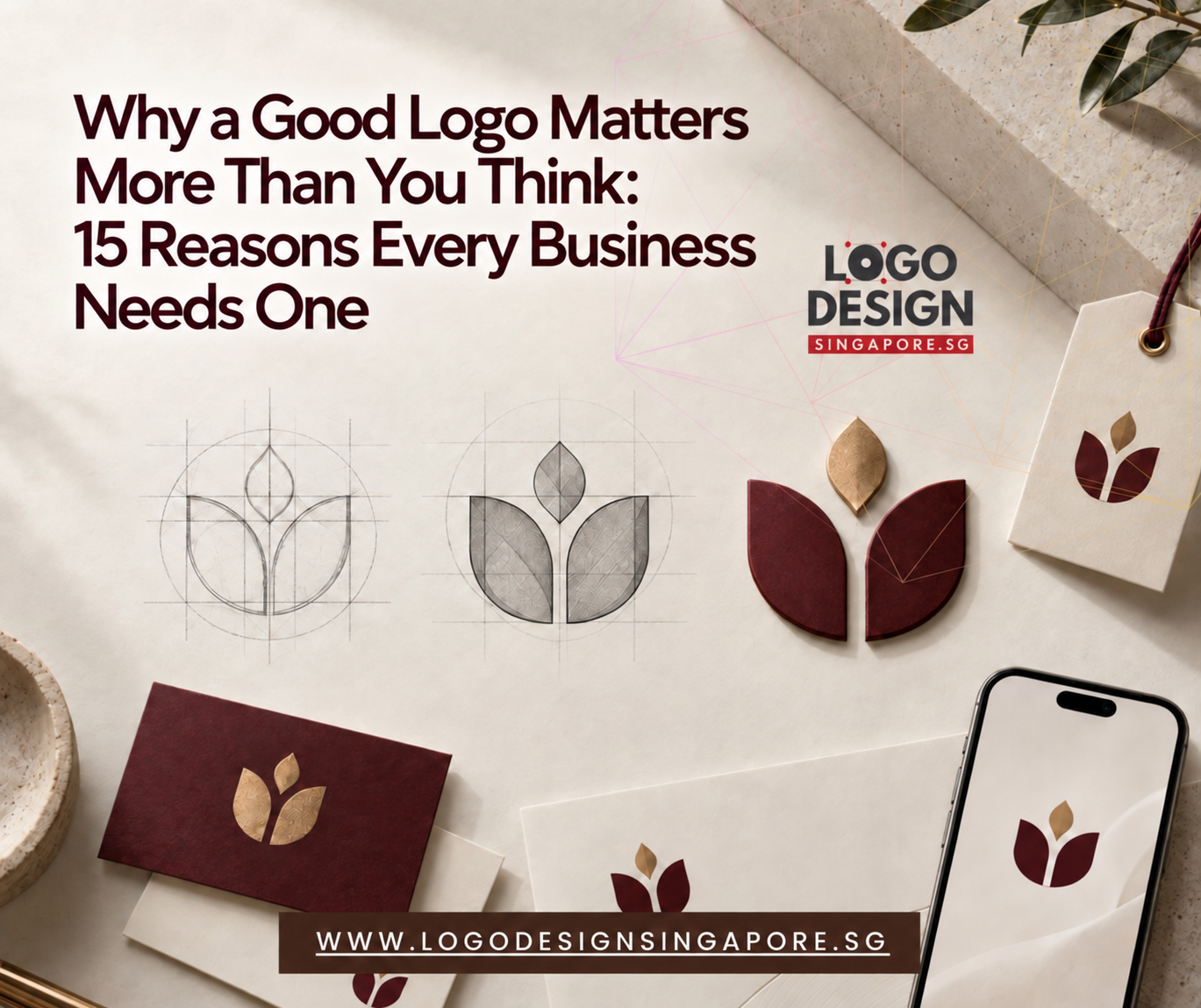 From rough sketch to final mark. How a logo takes shape across your brand materials.[/caption]
What Is a Logo, and Why Does Your Business Need One?
A logo is a visual identifier that represents a business, organisation, product, or service, a company name in a distinctive typeface, a symbol, an abbreviation, or some combination of these.
Its primary job is identification. Imagine receiving an invoice, visiting a website, and seeing a delivery vehicle from the same company. A consistent logo connects all three experiences to one business in your mind, instantly.
That consistency matters most when customers are comparing several businesses offering similar products or services. But there's a distinction most business owners overlook.
Logo vs. Brand vs. Brand Identity - What's the Difference?
These terms get used interchangeably, but they mean different things.
Your logo is the visual mark that identifies your business. Your brand identity is the wider system built around colours, typography, photography, illustration style, and communication tone. Your brand is the sum of perceptions people form through their actual experiences with you.
A restaurant can have a beautiful logo. Customers will still judge it on food, service, atmosphere, pricing, and consistency. The logo helps them identify the restaurant; the full experience is what shapes their opinion of it.
This distinction matters because good professional logo design should support your business identity, not attempt to replace everything else involved in building a real brand.
15 Reasons Why a Good Logo Matters for Your Business
A good logo is both a practical business tool and a creative design. Here's why it's worth real time and thought.
1. A Good Logo Creates a Strong First Impression
First impressions matter most when a customer doesn't know your company yet.
Picture two accounting firms offering similar services. One has a clean logo used consistently across its website and stationery. The other uses a dated graphic with cramped lettering and clashing colours. Before either firm proves anything about its qualifications, a potential customer has likely already formed a different opinion of each one's professionalism.
A well-designed logo doesn't prove a business delivers better service, but presentation shapes how strangers judge an unfamiliar company, especially before a track record exists. That's exactly why it matters most for startups with no reputation yet to lean on.
2. It Makes Your Business Easier to Recognise
Customers rarely meet a company through only one channel.
Someone might spot your ad on social media, visit your website days later, then walk past your shop or see your packaging. A consistent logo is what connects those separate encounters into one company in their mind.
Think about how you recognise familiar businesses from their logo alone, without needing the full name. That recognition builds through repeated exposure. Using the same core logo across your website, social accounts, signage, and print materials makes that recognition happen faster and reduces confusion when customers are comparing you to competitors.
3. A Memorable Logo Helps Customers Remember Your Company
Recognition and recall aren't the same thing. Recognition is identifying something when you see it. Recall is remembering it once it's no longer in front of you.
A distinctive logo supports both. Someone notices your delivery van on the way to work; weeks later they need exactly what you offer. If your logo was clear and distinctive, they're far more likely to recall your name. A cluttered logo with too many small details makes that harder which is why experienced designers favour clarity over complexity. The goal isn't fitting every detail of your business into one symbol; it's creating something customers can actually hold onto.
4. It Helps Differentiate Your Business From Competitors
Many industries lean on the same visual shorthand. Tech companies default to geometric symbols. Property agencies use rooftops. Cleaning companies reach for bubbles and sparkle icons. None of these choices are wrong on their own.
The problem starts when five property agents use almost the same generic rooftop icon. Strip away the company names, could a customer actually tell them apart?
A custom logo doesn't need to be unusual or experimental to solve this. Sometimes one carefully chosen typeface or a single distinctive letterform is enough. The real question is simple: does your logo look like it belongs to your business, or could it belong to anyone in your industry?
5. Professional Logo Design Supports Business Credibility
Customers look for reasons to trust a business they don't know yet but your website, reviews, portfolio, and general presentation all factor in. Your logo is part of that overall impression.
A poorly executed logo can quietly undercut the quality you're trying to communicate. A corporate consultancy using a stretched, pixelated logo on its site risks suggesting carelessness it doesn't actually have. A clean, properly proportioned logo removes that distraction, though credibility ultimately has to be earned through the business itself. A good logo can't compensate for misleading claims, poor service, or a disappointing product. Its job is to support a presentation that matches the quality already behind it.
6. Your Logo Forms the Foundation of Your Brand Identity
A logo is usually the starting point for a company's visual identity. Once it's set, its colours, typography, and proportions inform everything built on top of it.
A minimalist logo tends to lead toward clean typography, generous spacing, and a restrained palette. A children's education centre's logo might call for something more expressive and friendly. These decisions should be made together, not separately , otherwise you end up with a corporate-looking website, a playful brochure, and social graphics that feel like they belong to a third company entirely. A thoughtfully designed logo gives you one coherent starting point instead of three disconnected ones.
7. It Creates Consistency Across Your Marketing Materials
Your logo needs to work everywhere your business shows up, including:
- Websites and mobile apps
- Facebook, Instagram, LinkedIn, and other social platforms
- Business cards and letterheads
- Quotations, invoices, and proposals
- Product packaging and labels
- Shopfronts, signboards, and vehicle graphics
- Staff uniforms and promotional merchandise
Each of these has different technical demands. A detailed horizontal logo might look sharp on a website header and become unreadable shrunk down to a social profile picture. A design that leans on gradients may not embroider cleanly onto a uniform at all. This is why professional business logo design plans for horizontal, stacked, symbol-only, full-colour, and monochrome versions from the start. All belonging to one identity system, not looking like unrelated logos stitched together.
8. Your Logo Communicates Your Brand Personality
A logo can't communicate every detail about your business, but its visual language does suggest certain characteristics. Delicate serif type, generous spacing, and restrained colour say something very different from bold lettering, rounded shapes, and a vibrant palette, even when both are professionally executed.
This matters most when you're serving a specific audience. A luxury jeweller and a children's entertainment brand shouldn't share a visual treatment, and neither should a traditional law firm and an experimental consumer startup. Decide how you want customers to perceive you first, then translate that into visual choices, not the other way around. Avoid picking colours or symbols because they're trending; your identity should reflect your positioning and your audience, not the moment.
9. A Good Logo Helps a Small Business Present Itself Professionally
Large corporations have marketing budgets and existing recognition to lean on. Smaller businesses have to build recognition from zero, which makes consistent, professional presentation even more valuable.
A startup doesn't need an elaborate brand package or an expensive logo but it needs something clear, appropriate, and usable. A small home-based bakery might only need a logo for packaging stickers, social media, a simple website, and a basic signboard at first. A well-designed identity meets that need now while still working if the bakery later opens a physical shop. The point isn't to make a small company look like a multinational, it's to help the business present itself clearly at the stage it's actually at.
10. A Versatile Logo Works Across Different Sizes and Applications
The real difference between an attractive graphic and a functional logo is versatility. A design can look impressive on a large monitor and fail completely printed on a pen. Another might work beautifully in colour and disappear in black and white.
Test any logo against these questions:
- Can customers read the company name when it's small?
- Does the symbol still work without colour?
- Does it hold up on both light and dark backgrounds?
- Will it print clearly on business cards, packaging, and signage?
- Does it stay legible on a mobile screen?
A logo shouldn't need ideal conditions to function. If it only works at one size or against one background, it becomes a growing limitation as your business expands.
Will Your Logo Work Across Every Application?
A logo that looks good on a computer screen may not work equally well on business cards, packaging or signage. Our custom logo design services focus on creating practical, scalable designs suitable for different business applications.
Explore our logo design packages to find an option that suits your requirements. View Logo Design Packages
11. Logo Design Supports Familiarity and Long-Term Customer Relationships
Customers build relationships with businesses through repeated positive experiences. A recognisable logo helps them reconnect a new interaction to a business they already trust, you buy something once, have a good experience, then months later spot the same familiar logo on a different product. That visual recognition bridges the two.
The logo itself doesn't create the loyalty, though. Product quality, service, pricing, and convenience do that. The logo is simply the consistent visual thread tying those experiences together, which is exactly why businesses should be cautious about changing an established logo without a genuinely strong reason.
12. A Good Logo Supports Marketing and Advertising
Marketing campaigns shift throughout the year: a new product, a seasonal offer, an upcoming event. The messages change; your logo is what tells customers it's still the same business behind all of them.
A fitness company running separate campaigns for personal training, group classes, and corporate wellness needs one consistent mark connecting all three back to itself. Having the correct logo files also makes marketing production easier. Designers, printers and agencies can use the original artwork without recreating the logo or guessing its colours.
13. Logo Design Prepares Your Business for Future Growth
Businesses change. One product becomes several. A local provider expands into new neighbourhoods. A startup grows into an established company with a broader customer base.
Your logo shouldn't box that growth in. A bakery that starts with a highly literal birthday-cake illustration in its logo may find that design awkward once it expands into bread, pastries, and catering. That doesn't mean descriptive logos are always wrong, it means the design should reflect where the business is likely heading, not just what it sells today. When designing a logo, think a few years past your current offering. A flexible identity reduces how often you'll need a full redesign later.
14. Professional Logo Design Can Prevent Avoidable Redesign Costs
A cheap logo or a quickly generated AI logo can look economical at first. Problems tend to surface once the business starts using it across more applications, missing vector files, unclear ownership rights, unsuitable typography, or artwork that simply can't be reproduced properly.
Picture printing a large batch of packaging before discovering the logo turns blurry at that size. Or commissioning vehicle graphics only to learn the original "designer" supplied a small JPEG instead of editable vector artwork. Fixing these problems later means paying for the design work twice. For a full breakdown of what proper logo design should cost in Singapore and why, see our logo design cost guide.
15. Your Logo Can Become a Valuable Business Asset
As a company grows, its logo becomes increasingly tied to specific products, services, and experiences in customers' minds. That accumulated recognition has real business value and a logo can become part of your intellectual property portfolio.
Commissioning a logo, though, doesn't automatically hand you trademark registration or settle every copyright question. Understand your contractual ownership rights, and consider whether trademark protection makes sense for your business. In Singapore, trademark registration runs through the Intellectual Property Office of Singapore (IPOS), if long-term protection matters to you, get proper professional advice and check whether your proposed logo conflicts with existing rights.
A distinctive logo isn't a decorative expense. It's a real, identifiable business asset that deserves proper design, management, and protection.
What Happens When Your Logo Is Poorly Designed?
A poorly designed logo makes it harder for customers to tell you apart from competitors and the problems compound from there.
A cluttered logo becomes unreadable on a mobile screen or a business card. Poor colour choices kill contrast, and decorative typography can make your own company name hard to read. Technical issues are just as common: businesses often discover, too late, that the only file they have can't be enlarged for signage without losing quality or that a logo designed purely in colour falls apart the moment it needs to print in black and white. Each of these can quietly disrupt printing, embroidery, packaging, and advertising down the line.
Check for originality, too. Artwork that closely resembles an existing business's identity risks confusing customers and inviting legal trouble. The real test of a logo isn't how it looks on a screen but it's how well it actually functions.
Do Small Businesses and Startups Really Need a Professional Logo?
Yes, but the investment should match your actual needs and budget, not the other way around.
A startup launching its first product doesn't need a full corporate branding programme. What it does need is a clear visual identity that works across its essential channels: website, business cards, invoices, social profiles. Without an established logo, each of those tends to end up looking like it belongs to a different company, which creates exactly the wrong kind of inconsistency at the exact moment you're trying to build recognition.
A simple, well-executed logo with the right files and clear usage guidelines will do more for you than an elaborate package full of materials you don't need yet. Plan for immediate needs alongside reasonable future growth, a logo that fits the business you run today without becoming unworkable the moment you scale.
Custom Logo Design vs. Free Logo Makers vs. AI Logo Generators
With so many tools available, the real question isn't whether one option is universally "best" it's which one matches your budget, objectives, and how important a distinctive identity is to you right now.
[caption id="attachment_32419" align="aligncenter" width="1410"]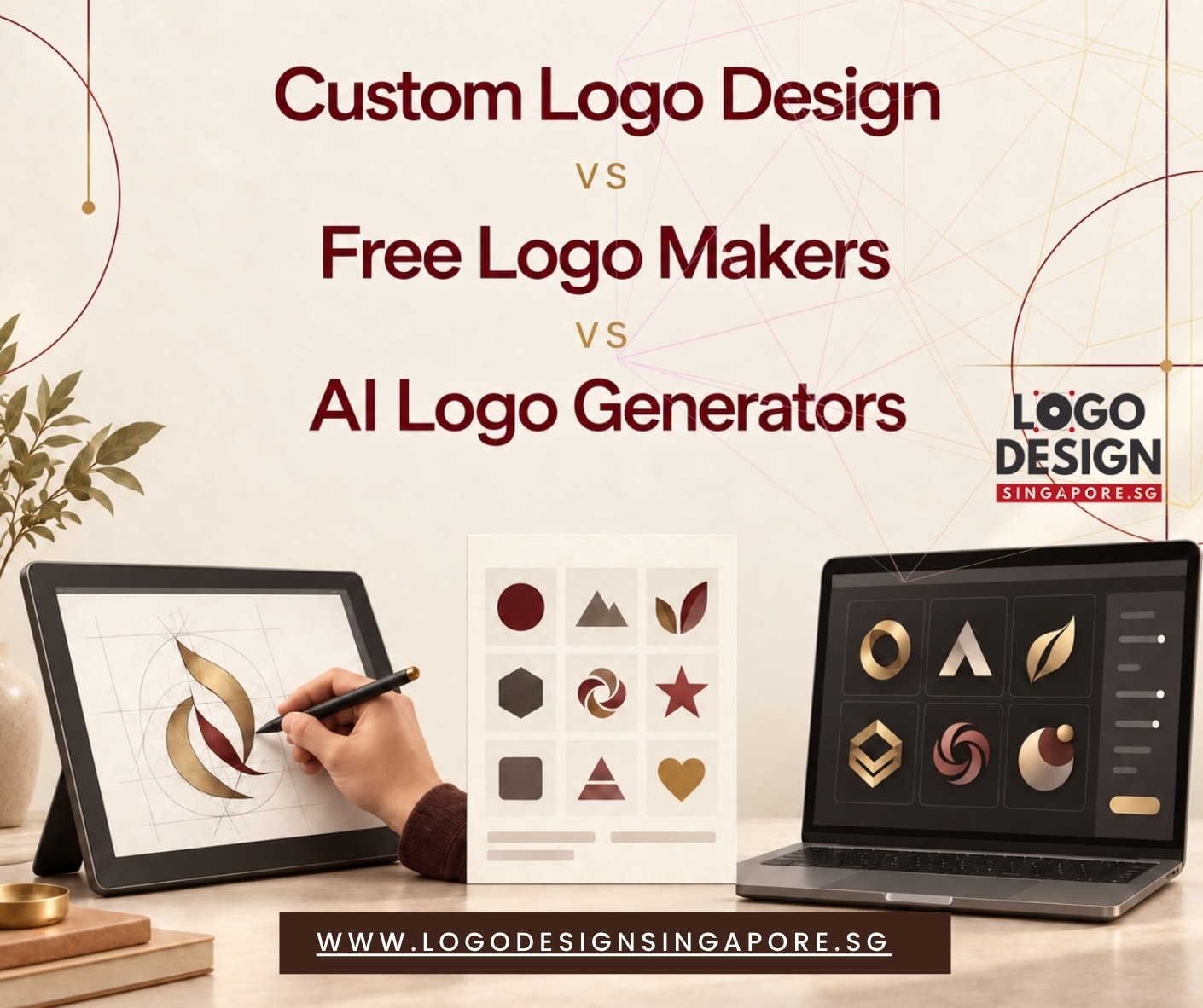 Three different paths to a logo and what each one actually gives you.[/caption]
Free logo makers let you build something quickly from templates. They're fine for a temporary project or testing an idea on a tight budget, but customisation limits, commercial usage rights, and file formats vary widely between platforms, and other businesses may well be using the same templates. Check the licensing terms and what you actually get to keep before committing.
AI logo generators can produce concepts fast and help you explore directions. But generating an attractive image isn't the same as producing a complete, production-ready logo. Originality, ownership, typography, scalability, and proper file preparation still need real attention. AI output often needs substantial refinement before it's genuinely fit for commercial use.
Professional custom logo design starts from the business itself, your company, your audience, your competitors, your intended applications before moving into concepts, refinement, and final artwork. It doesn't guarantee commercial success, but it's a far more deliberate process for building an identity that actually fits what you need. If you're planning a long-term brand, this is the option worth the investment.
When Should You Redesign Your Logo?
Not automatically, and not just because you've used the same one for years. If customers already recognise it and it's still doing its job, changing it without a clear reason can cost you recognition you've already built.
A redesign becomes worth considering when your current logo is creating real problems when your business has expanded into new services, your target audience has shifted, or your original logo is technically unsuited to modern digital use. Often, a refresh (improving typography, spacing, proportions, and colour while keeping recognisable elements) solves the problem better than a full redesign. The right call depends on how strong your current recognition is and what you actually need your identity to communicate so identify the specific problem first, rather than asking for "something that looks newer" with no clear goal behind it.
Real-World Examples of Effective Logo Design
A handful of well-known brands show how far a simple visual choice can go.
Nike's swoosh proves a symbol can eventually stand entirely on its own, once recognition is high enough. Apple's silhouette works because it reproduces cleanly across every product and material it touches. McDonald's golden arches show how one consistent visual element builds recognition across thousands of locations. The FedEx logo demonstrates clever use of negative space, with an arrow formed between the letters 'E' and 'x'.
These are useful design lessons, but it's worth being honest about them: none of these companies succeeded because of their logo alone. Years of advertising, product development, and customer experience did the heavy lifting. For a smaller business, the lesson isn't to copy a famous brand's visual style, it's to build something distinctive and apply it consistently, starting now, however small your current footprint is.
Want to see what that looks like for a Singapore business specifically? Browse our logo design portfolio for real examples across different industries.
Looking for Professional Logo Design in Singapore?
Your logo is more than a visual element on your website or name card. It represents your business across different platforms and should remain clear, recognisable and practical wherever it appears.
At Logo Design Singapore, we provide custom logo design services for startups, SMEs and established businesses. Our design process begins with understanding your business requirements and preferred direction before developing and refining the logo concepts.
We offer different logo design packages with varying numbers of concepts and revision rounds, allowing you to choose an option that suits your requirements and budget. We also handle related work, including website design and marketing collateral, so your visual presentation stays consistent across everything.
Whether you need a logo for a new business or are considering redesigning an existing one, explore our packages or contact us to discuss your project.
Ready to Get Started?
Choose a Logo Design Package that suits your business or tell us more about your project.
Frequently Asked Questions
1. Why is a logo important for a business?
A logo gives your business a recognisable visual identity across your website, social media, packaging, advertising, and every other channel you use. It supports consistent branding and professional presentation. It can't guarantee success on its own, but it plays a real role in how customers recognise and remember you.
2. What are the main benefits of having a good logo?
Recognition, differentiation, memorability, consistency, and a professional first impression. A well-designed logo also gives your marketing materials a visual foundation that works across different applications without losing clarity as customers build a history of experience with your brand.
3. Can a good logo help attract customers?
It contributes to a professional, attractive first impression that shapes how strangers perceive an unfamiliar business, but customers also weigh pricing, reviews, product quality, and service. A logo works best as one part of a business that already delivers genuine value.
4. Does a professional logo increase sales?
Not automatically. It supports recognition and helps your marketing materials stay consistent, but sales depend on demand, pricing, product quality, marketing, and service. Think of logo design as one piece of a broader business strategy, not a standalone growth lever.
5. What makes a good company logo?
Distinctive, relevant, memorable, versatile, and easy to recognise at a glance. It should stay readable at different sizes and work across both digital and print. The strongest logo isn't the most complicated one, it's the one that actually meets your business's needs.
6. Should a business logo be simple or detailed?
In most cases, simplicity makes a logo easier to recognise and reproduce. Some organisations do benefit from a more detailed emblem, but even a detailed logo needs a clear visual hierarchy and has to stay functional at the sizes where it'll actually be used.
7. What is the best colour for a business logo?
There's no single best colour for every logo as it depends on your positioning, audience, industry, and practical requirements like contrast and how the colour reproduces in print versus digital. A professional designer evaluates your whole visual identity rather than picking a colour off a generic "colour psychology" chart.
8. Does a logo need to show what the company does?
No. Many effective logos rely on typography or abstract symbols that become associated with the business purely through consistent use. A descriptive symbol can work, but it shouldn't box in your identity if your products or services change later.
9. Can a business succeed without a logo?
Yes, especially in the early stages. But a consistent visual identity helps customers recognise and distinguish your business from competitors and as you grow, investing in the right logo becomes increasingly useful for marketing, packaging, signage, and everything else you'll eventually need it for.
10. Why should a small business invest in professional logo design?
Small businesses need to build recognition without the marketing budgets larger companies have. Professional logo design gives you a consistent identity across essential materials like websites, invoices, business cards, social profiles and helps you avoid practical problems later when you need printing, signage, or additional branding materials.
Planning a new business logo or considering a redesign? Explore our custom logo design services in Singapore to learn about our packages, design process and final deliverables.[/vc_column_text][/vc_column][/vc_row]
Categories: Blog